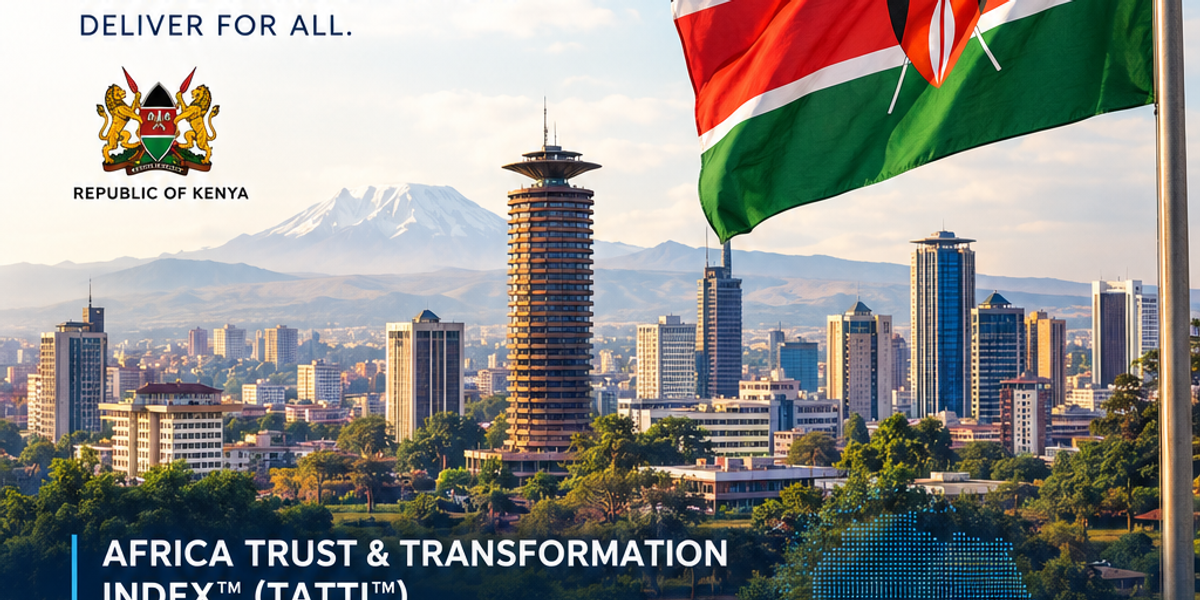
TRT Africa Trust & Transformation Index™ (TATTI™): Kenya 2026 Country Assessment
05 Oct 2026
Kenya scores 63.2 on TATTI™, High trust-deficit exposure. The 2026 pattern is stable money but a contested state: macro stability is holding while fuel prices, protest policing, county service failures and debt service erode trust ahead of the August 2027 General Election.
Kenya registers a TATTI™ composite of 63.2 in 2026, High trust-deficit exposure and 2.2 points above the Moderate ceiling. The defining pattern is stable money, contested state. The Central Bank of Kenya has held inflation inside its target range, the shilling steady and reserves at 6.3 months of import cover. Yet fuel-price shocks, protest policing, county service breakdowns and a debt-service squeeze drive the deficits citizens feel directly.
The deficit is concentrated in peace, security and stability (71), social cohesion (70) and economic and livelihood trust (66). The Trust Restoration Capacity Score™ is 49.4. Oversight institutions such as KNBS, the Controller of Budget, the Auditor-General and the courts detect problems early and publicly, while accountability and crisis communication remain the weakest links. The Transformation Delivery Gap™ stands at 63.1, widest on police accountability, pending bills and fiscal consolidation.
With the General Election scheduled for 10 August 2027, and 76% of Kenyans telling TIFA the country is headed in the wrong direction, the assessment maps four transmission chains that converge on June–August 2027. It sets out 23 early-warning indicators to monitor and proposes verifiable ledgers rather than new pledges. These include a public-order policing accountability ledger, a published fuel-price stabilization account and an IEBC technology-audit calendar.
TATTI™ measures trust conditions, not political performance. This is an independent TRT Intelligence Institute™ assessment, not a United Nations or African Union publication.