
Trust Index Finds Gap Between Ghana's Macroeconomic Indicators and Public Service Experience
TRT Intelligence, Messan Mawugbe(PhD)· Accra
Ghana has posted a composite score of 57.9 on the inaugural TRT Africa Trust & Transformation Index (TATTI™), placing the country in the “moderate trust-deficit” band — just 3.1 points short of the “high” threshold, according to the index’s 2026 pilot assessment.
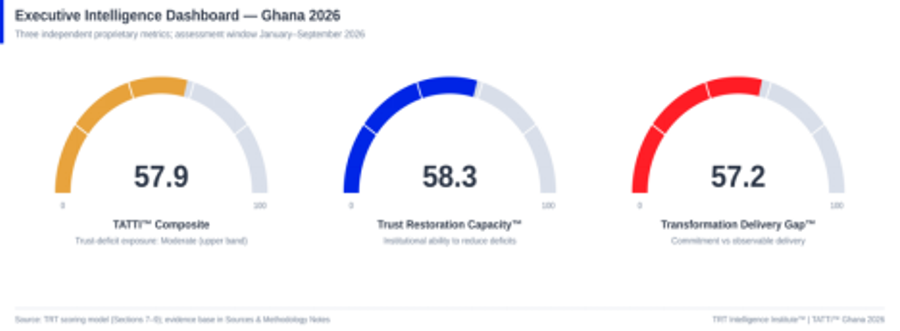
Ghana's three headline TATTI™ scores for 2026, each measured on a 0–100 exposure scale.
The report describes a “macro–lived trust divergence”: institutional and macroeconomic credibility have recovered faster than citizens’ everyday experience of the state.
“The central finding is not that Ghana’s institutions are failing, but that improvements at the macro and institutional level are not yet translating consistently into the everyday experiences that shape public trust,” said Messan Mawugbe, PhD, Lead Analyst at TRT Intelligence Institute™. “The trust challenge, therefore, is increasingly about closing the distance between what national indicators show and what citizens encounter at the point of service.”
On the macro side, the IMF completed its Extended Credit Facility programme in July 2026, inflation eased to 5.0% in August — within the Bank of Ghana’s target band — and debt-distress risk was upgraded to moderate. Fitch, Moody’s and S&P have all affirmed positive or stable outlooks.
At the level of citizen experience, the report cites different trends. Ghana Statistical Service data show the share of citizens reporting a bribe payment increased from 14.3% to 18.0% between the first and second halves of 2025, with a larger share of those bribes reported as solicited by officials. The Auditor-General recorded irregularities of GH¢5.266 billion for FY2025, the highest figure in five years, while water-treatment intakes near mining sites recorded turbidity levels above permitted limits in August 2026. The report also notes payment arrears to cocoa farmers over several months in late 2025.
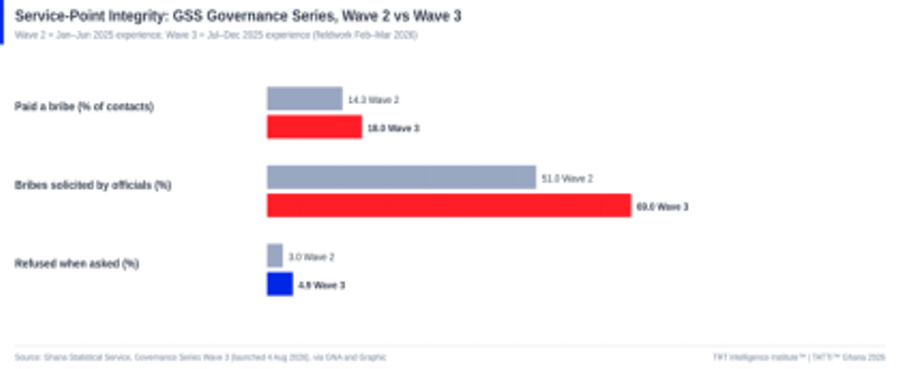
Reported bribery and solicitation rates at public service points increased between the two halves of 2025, per Ghana Statistical Service data.
According to the index, justice and institutional integrity, along with social cohesion, are the pillars with the highest recorded trust deficit. The report associates these pillars with points of direct contact with public services, including checkpoints, health facilities, passport offices and water infrastructure.
The report also notes that domestic debt maturities are scheduled for 2027–2028, ahead of Ghana’s next general election in December 2028, and identifies this period as one to monitor for changes in the gap between institutional and citizen-level trust measures.
The assessment states it measures trust conditions rather than political performance, and does not rank leaders or predict election outcomes.
Lead Analyst: Messan Mawugbe, PhD
Managing Director, TRT Intelligence Institute™
Based on TRT Africa Trust & Transformation Index™. Analytical judgements are intelligence assessments, not forecasts, allegations or governance ratings. Messan Mawugbe(PhD), Founder and Lead Risk Architect at TRT Intelligence, is a data scientist and corporate risk strategist with over 20 years’ experience in narrative intelligence, institutional risk and strategic data analysis.