
Togo's Measured-Lived Gap: Low Inflation on Paper, Cost Pressure at Home
A new country assessment from the TRT Intelligence Institute finds Togo's 2026 trust conditions shaped by a gap between strong macroeconomic indicators and household-level pressure. The report scores the country 69.7 out of 100 on its Trust & Transformation Index (TATTI), in the “High exposure” band.
Macro-financial figures are favourable. Annual average inflation stood at 0.3% in July 2026, among the lowest in the West African Economic and Monetary Union, and public debt has returned below the community ceiling. The IMF programme has met most benchmarks, and reforms including universal health insurance and wider water coverage are under way.
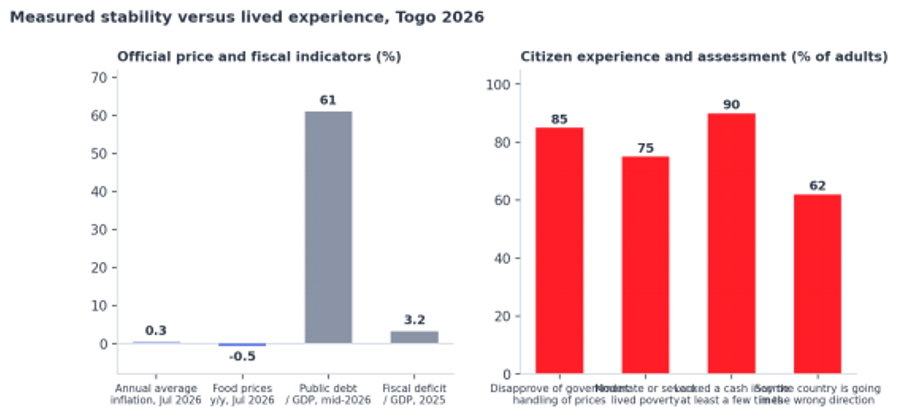
Official price and fiscal indicators contrast with citizen-reported experience of prices, income and direction of the country. Sources: INSEED/FEWS NET, IMF, Afrobarometer Round 10 (2024), TATTI™ assessment.
Household-level indicators diverge from that picture. In Afrobarometer's most recent survey, 75% of adults reported moderate or severe lived poverty and 85% disapproved of the government's handling of prices. Pump prices rose more than 20% over four months to CFAF 817 per litre, and a fuel-cost mobilisation was announced from 12 September, with further sit-ins planned for October.
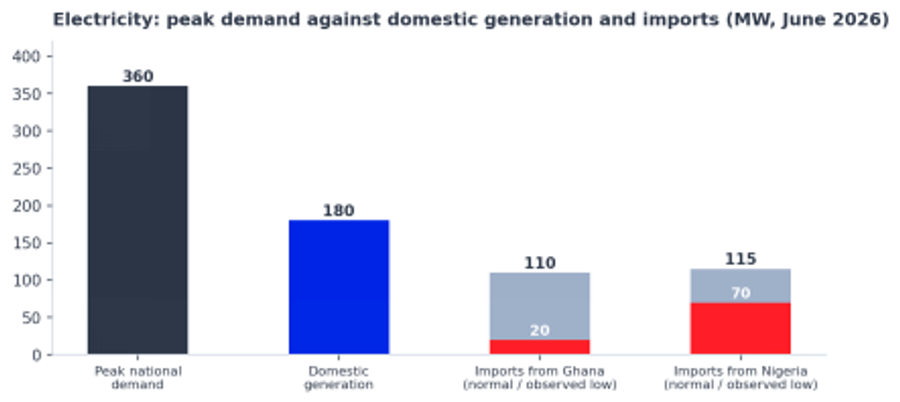
National electricity peak demand against domestic generation and imports, June 2026. Source: Ministry Delegate for Energy and Mineral Resources, TATTI™ assessment.
Electricity supply is a specific pressure point: peak demand of 360 megawatts is met by roughly 180 megawatts of domestic generation, with the remainder covered by imports from Ghana and Nigeria that the report says have run below normal levels this year. A fifth twelve-month extension of the Savanes state of emergency and expanded prosecution of online speech are also cited as factors in a narrowing civic space.
“Togo's institutions have shown they can design and pass reforms quickly — the constraint is not capacity, it is verifiability,” said Messan Mawugbe(PhD), Lead Analyst at the TRT Intelligence Institute. “The state publishes what it has decided more readily than what it has delivered, and that gap is where trust is lost.”
The assessment concludes that publishing a fuel price formula, load-shedding data and commune-level transfer records would offer a verifiable, low-cost path toward narrowing the gap, ahead of a sensitivity window it identifies running to mid-2027.
Lead Analyst: Messan Mawugbe(PhD)
Managing Director, TRT Intelligence Institute™
Messan Mawugbe(PhD), Founder and Lead Risk Architect at TRT Intelligence, is a data scientist and corporate risk strategist with over 20 years’ experience in narrative intelligence, institutional risk and strategic data analysis.
Source: TRT AFRICA TRUST & TRANSFORMATION INDEX™ (TATTI™), Togo 2026 Country Assessment, TRT Intelligence Institute™ (West African Pilot Edition, September 2026). Independent assessment; not a United Nations or African Union publication or endorsed methodology.