
Nigeria's 2026 Trust Paradox: Macroeconomic Gains Meet Persistent Citizen Hardship
Source: TRT Intelligence Institute, Messan Mawugbe(PhD) Nigeria 2026 Country Assessment (TATTI™)
A new country assessment from the TRT Intelligence Institute finds Nigeria's macroeconomic recovery in 2026 has yet to translate into improved public trust, even as key indicators show measurable progress.
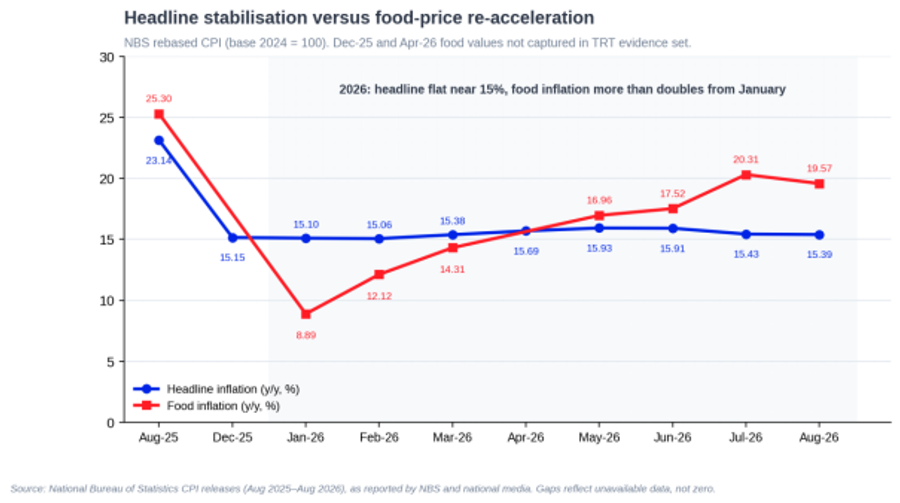
Headline inflation fell to 15.39% in August 2026, down from 23.14% a year earlier, while foreign reserves reached $54.08 billion in early September — an 18-year high — and real GDP grew 4.43% year-on-year in the second quarter. The IMF's June 2026 Article IV review credited the country's reform programme, which includes fuel-subsidy removal, exchange-rate unification and new tax legislation, with strengthening macroeconomic stability.
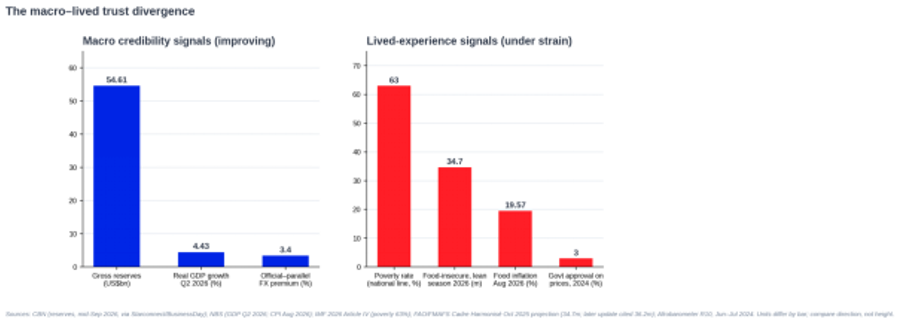
However, the report's Trust & Transformation Index (TATTI) scores Nigeria at 68.7 out of 100 — in the “High exposure” band — arguing that these gains remain concentrated among investors and financial institutions rather than reaching ordinary citizens.
"Nigeria's numbers are moving in the right direction, but macroeconomic recovery and public trust operate on different timelines. Reserves and reform indicators can improve inside a fiscal quarter — a household's sense of security around food and safety takes much longer to rebuild”, said Messan Mawugbe, PhD, Lead Analyst at TRT Intelligence Institute™.
The IMF itself noted that poverty affects 63% of the population, with food insecurity projected to worsen. Food inflation stood at 19.57% in August, well above the headline rate, and the UN's Cadre Harmonisé framework projected roughly 35 million people could face severe food insecurity during the 2026 lean season.
Security emerged as the report's most critical pillar, scoring 84 out of 100. Analysts cited by the assessment described the second quarter of 2026 as Nigeria's most violent since 1997, with rising civilian targeting by armed groups in the north.
The report also flags unresolved governance questions, including delayed implementation of a 2024 Supreme Court ruling on direct local-government funding, and notes Nigeria's Corruption Perceptions Index score remained unchanged at 26 out of 100.
The assessment, produced independently and not affiliated with the UN or African Union, concludes that verifiable, incremental delivery — rather than new policy announcements — offers the most credible path to narrowing the gap between reform outcomes and public confidence ahead of Nigeria's January 2027 elections.
Lead Analyst: Messan Mawugbe, PhD
Managing Director, TRT Intelligence Institute™
Messan Mawugbe(PhD), Founder and Lead Risk Architect at TRT Intelligence, is a data scientist and corporate risk strategist with over 20 years’ experience in narrative intelligence, institutional risk and strategic data analysis.
Source: TRT AFRICA TRUST & TRANSFORMATION INDEX™ (TATTI™), Nigeria 2026 Country Assessment, TRT Intelligence Institute™ (West African Pilot Edition, September 2026). Independent assessment; not a United Nations or African Union publication or endorsed methodology.