
Access Bank Ghana: Strong Position, but Moving Against the Sector
Access Bank (Ghana) PLC remains strongly capitalised, liquid and profitable, but a TRT Intelligence Institute™ assessment identifies an emerging divergence in its credit-risk trajectory that warrants closer early-warning monitoring.
TRT places Access Bank’s latent credit-risk exposure at 60.9/100 — “Elevated.” The score does not indicate distress or an immediate capital concern. Rather, it reflects unresolved risk signals that may not yet be fully visible in conventional financial reporting.
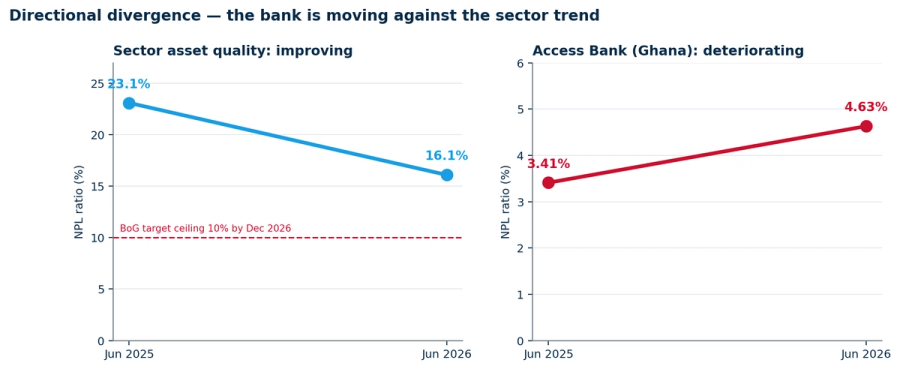
The key finding is the bank’s movement against an improving sector. Between June 2025 and June 2026, Ghana’s banking-sector NPL ratio fell from 23.1% to 16.1%, while capital adequacy increased from 17.5% to 22.3%. Over the same period, Access Bank’s NPL ratio increased from 3.41% to 4.63%, while its capital adequacy ratio declined from 19.08% to 18.20%.
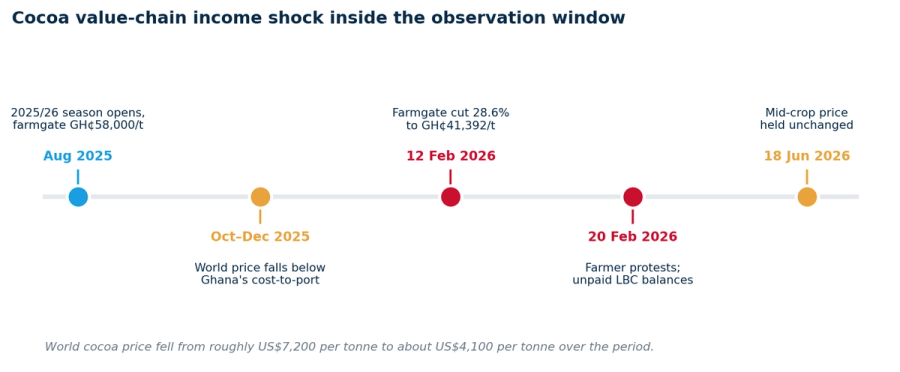
TRT identifies five priority risk pathways: cocoa-sector exposure following the 28.6% fall in farmgate prices; large-ticket corporate concentration; seasoning of the FY2025 loan expansion; movement in credit-risk reserves against rising NPLs; and potential transmission of public-sector and contractor arrears.
The cocoa exposure is particularly relevant. Access Bank launched a cocoa lending product during FY2025, when gross loans expanded by 38%, creating a risk channel that warrants monitoring as the sectoral income shock develops.
The assessment nevertheless finds significant resilience. Net interest income rose 26.4% to GH¢326.4 million, equity increased 12.5% to GH¢2.32 billion, and the bank’s NPL ratio remains well below the sector average.
TRT therefore recommends enhanced observation rather than a change in credit strategy, with priority given to Stage 2 exposure, cocoa/agriculture past-due balances, restructured and forborne loans, deposit composition, and impairment charges relative to pre-provision profit.
“A strong bank moving quietly in the wrong direction during good conditions is the specific pattern early-warning intelligence exists to catch.”
TRT Intelligence Institute™ — Threat • Risk • Trust Intelligence
Lead Analyst: Messan Mawugbe, PhD
Managing Director, TRT Intelligence Institute™
Based on TRT Intelligence Institute™’s Q1–Q2 2026 Latent Credit Risk & Threats Intelligence Assessment. Analytical judgements are intelligence assessments, not forecasts, allegations or credit ratings.