

Absa Ghana’s Credit Growth Accelerates as NPL Ratio Falls, but Risk Signals Move Beneath the Surface
Absa Bank Ghana enters the second half of 2026 with stronger asset quality, robust capital and rapid credit expansion. However, a TRT Intelligence Institute™ Latent Credit Risk Assessment finds that the bank’s emerging credit-risk challenge may lie less in current loan performance and more in the seasoning of its rapidly expanding portfolio.
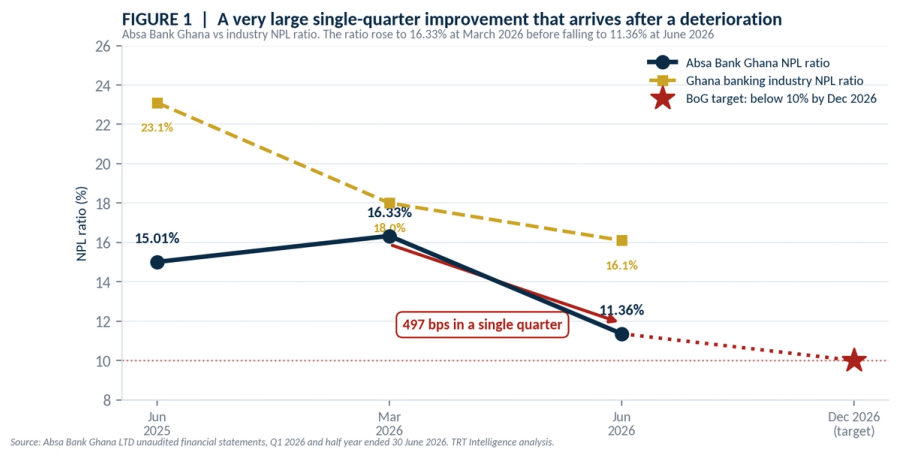
Absa’s NPL ratio declined to 11.36% in June 2026, from 15.01% a year earlier and 16.33% in March. Capital adequacy stood at 24.0%, deposits grew approximately 37%, and total assets increased 30.4% to GH¢35.49 billion.
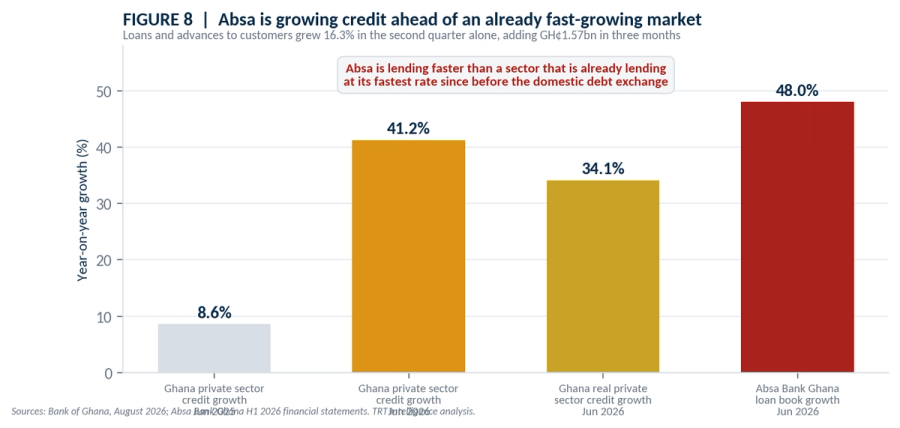
More significantly, loans and advances expanded 48% year-on-year to GH¢11.18 billion, outpacing Ghana’s private-sector credit growth of 41.2%.
TRT’s assessment does not interpret this growth as evidence of deterioration. Instead, it identifies a potential timing gap between credit origination and the visibility of emerging risk. Newly originated 2026 loan vintages may require further seasoning before weaknesses become evident in conventional NPL indicators.
The bank’s impairment charge also increased to GH¢127.4 million in H1 2026, compared with a GH¢68.6 million release a year earlier, while the credit-risk reserve rose to GH¢338.3 million.
TRT therefore recommends close monitoring of 2026 credit vintages, impaired balances alongside the NPL ratio, provisioning movements, and net interest margin against cost of risk.
The central finding is straightforward:
The issue is not whether Absa is growing, but whether risk visibility is growing at the same speed.
TRT Intelligence Institute™
Threat • Risk • Trust Intelligence
Lead Analyst: Messan Mawugbe, PhD
Managing Director, TRT Intelligence Institute™
Based on TRT Intelligence Institute’s Q1–Q2 2026 Latent Credit Risk Assessment of Absa Bank Ghana. Analytical judgements are intelligence assessments, not forecasts, allegations or credit ratings.